

Skip to content

Support better teaching across every section.

Bring lesson planning, student progress and school records together. Give teachers more time to teach, with school policies controlling how Peach's proposals are reviewed and released.

Attendance · Class 8 BRegister filled from yesterday. 1 change flagged.Confirm registerChangeNothing is recorded until you confirm.
Marking · Practical write upAarav links the trolley slowing to friction, but leaves out his 0.8 s reading. Ask him to use it in the conclusion.Rubric level 3 of 4 · suggestedAcceptEdit
Planning · Unit 4Draft written from the school template.Locked · awaiting your review
Message to Class 9 parentsTerm 2 reports are ready to collect on Friday.टर्म 2 की रिपोर्ट शुक्रवार को ली जा सकती है।Machine translated, original attached · Send after confirmation

Your week, start to finish

A week in Class 8 B, with you at every step.

From Monday's chapter plan to Thursday's follow-up. Leave it and it plays through. Pick a day to jump there.

You ask for the chapter plan. It lands in your school's template.
01Ask for the chapter in plain words
02Outcomes, the chapter test and six lessons fill your planner
03Change what you like, then publish it to the class
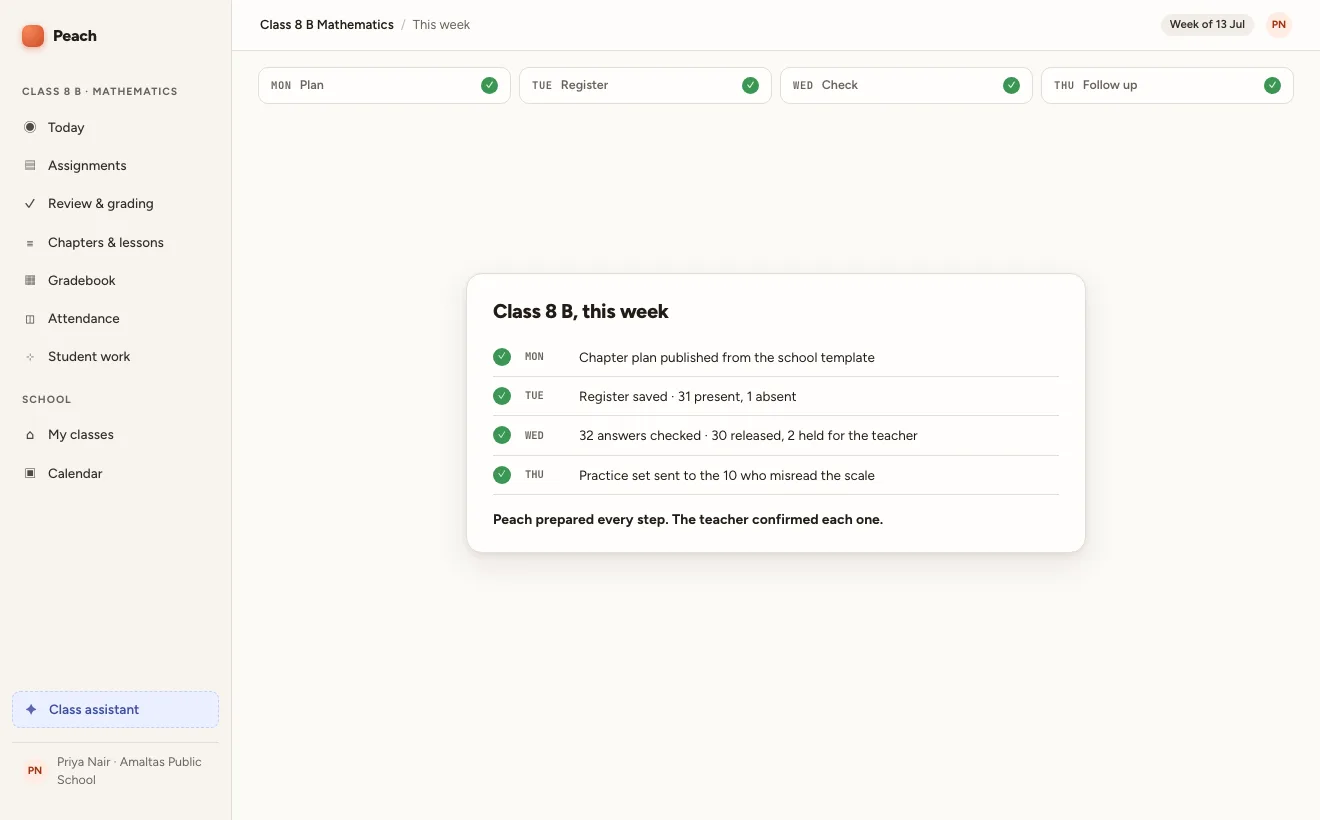
A week in Class 8 B with Peach: Monday a chapter plan drafted from the school template and published, Tuesday the register saved with one absence, Wednesday 32 quick check answers checked with two held for the teacher, Thursday a practice set sent to the ten students who misread the scale.
Peach prepares each step. You decide what goes out.

What a school gets

What Peach helps your school do better.

Support consistent planning, identify learning gaps, reduce correction work and follow up across sections. Each one in full, on the Outcomes page.

Class 8 B ScienceUnit 4 · Forces and motionLocked draft · not published
School template
Key question
Outcomes
Lesson sequence
Practical
Assessment
Differentiation
Written by Peach on 2 September from the brief S. Iyer approved
Why does a moving trolley stop on its own?
OutcomesExplains friction in own words. Uses measurement as evidence. Draws a fair conclusion.
Six lessonsTrolley and ramp practical over two trials, then conclusion writing with the class data.
AssessmentPractical write up marked against the school rubric.

Publishing a lesson draft

Review and publish a lesson in three clear steps.

A teacher approves a brief, Peach writes an unpublished draft, and the teacher edits and publishes it. Other workflows use their own controls: the school sets its AI grading policy, while attendance and guardian messages require staff confirmation.

01
The teacher approves a brief
What to make, for which class, against which template.
02
Peach writes a locked draft
Unpublished. Students and parents cannot see it.
03
The teacher reviews, edits, publishes
The teacher can change the draft before publishing. Important approvals and corrections stay in the history.
New assignmentClass 8 B Science
Brief, approved by S. Iyer at 8:29 am
Homework on friction for Class 8 B. Two short questions using the trial data from Tuesday's practical. Due Friday. Use the school rubric.
Locked draftWritten 8:31 am · not visible to students
Friction homework

1. Using your two trial readings, explain why the trolley took less time to stop on the carpet than on the desk.

2. Which reading is your evidence? Write one sentence that uses the number.

Built around your curriculum and classes

Lesson preparation based on your curriculum and your students.

The staff assistant only uses what that teacher is allowed to see. Her own classes, the school's templates, the rubric and the current term. Nothing else, and nothing copied in from outside the school.

A general chat prompt
Make a worksheet on friction for class 8.
The result depends on the context added to the conversation. The teacher would still need to connect it to Tuesday's practical, the rubric and the students who need the task.
Peach, in Class 8 B
Something for the nine who missed the trial data.
Class 8 B rosterUnit 4, lesson 3 of 6School rubricOutcome: uses measurement as evidenceTuesday's practical
A ten minute task for those nine students, using their own trial tables, marked against the same rubric line. Drafted as a locked, unpublished assignment for the teacher to review.

Teacher workload

Less routine work for your teachers.

Peach prepares the register, lesson drafts, marking proposals and guardian messages. School policies control release, and staff confirm attendance and messages before they are recorded or sent.

8:10 amAttendance for Class 8 A. Pre-filled from yesterday's register. She checks it and confirms.
8:30 amOpens the Unit 4 draft Peach wrote overnight from her brief. Cuts two lessons, publishes.
Free period31 marking proposals. Accepts 19, edits 12. Nothing goes to students until she releases it.
2:40 pmMessages three sets of parents. Each is drafted and translated, then sent only when she confirms.
EveningLess preparation to carry home.
Practical write up31 submissions · Class 8 BNothing released
Queue
Proposals · 31
Reviewed · 12
Released · 0
Rubric
Explains observation
Uses evidence
Fair conclusion
Aarav S.Submitted 2 September
Suggested by PeachUses evidence · level 3 of 4

Aarav describes the trolley slowing down correctly and links it to friction. The 0.8 second reading from his second trial is not used in the conclusion. Ask him to bring that measurement into it.

EditDiscard18 more awaiting review

Tasks that once took hours now take minutes. My students love the instant feedback.

AP
Alpana P.
Coordinator, Woodstock School

See how Peach would work in your school.

Set up your classes, import your people, and run one section on it this term.

Prefer email? kanishk@peach.study